 Ingathery
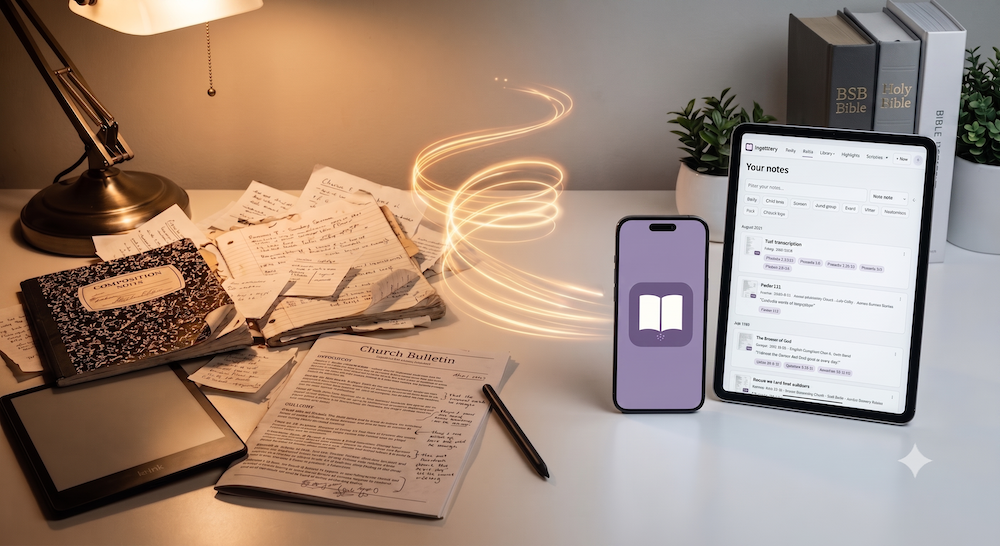
As Christians, if we regularly meet as part of a church (we we should do), then we will hear the Bible read and explained to us through sermons many times. This teaching is God given and important to our discipleship. However, it is easy to sit through the talk on a Sunday and learn little if we don't engage and dwell on the message we hear. Taking notes helps, but if those notes languish in a notebook, general notes app or on pieces of paper without being revisited then we won't learn and apply the teaching as well as we could do.
I've sat through thousands of sermons in my life. I was privileged to have been brought up in a Christian home, taken to church at least once a week all the way through childhood, and for God to have saved me and helped me to continued that through my adult life. That's thousands of hours of teaching that I've sat and listened to as sermons each week.
I've been very fortunate that a lot of that has been really high-quality expository Bible teaching by some pastors and other teachers who have really understood and delved into God's Word. That high-quality teaching, I heard, should have had lots of impact.
How much have I learned?
I've heard all that teaching. The question is how much of it have I actually learned? Yes I've taken in quite a lot over the years, but the specifics, the things that God was saying to me at that time, the detail that I was taught about the Bible and about the nuances of the passages, how it all fits together, a lot of that I don't remember. More importantly a lot of that is not continually impacting me in the way that it could do if I had learnt better what I was taught.
I think this is an issue for lots of us. We sit through sermons and at worst we struggle to concentrate on them and don't take much in at the time. We might do better if we take some notes, maybe the odd bit here or there, to help us to concentrate, maybe even more detailed notes that help us to pick out the key points that the preacher is making. Hopefully God is speaking through that person about the Bible. About what God is saying to us from it, and what the application should be to our lives.
But it's often that Sunday morning or Sunday evening time when we sit there for half an hour, 45 minutes, whatever it is, and we're listening to God's Word being opened and explained to us. We then go away and by Monday morning that's gone. We don't remember it because we haven't taken time to think about it later, to revisit it. We aren't dwelling on it.
Note taking helps
If we made notes it might be in a notebook, which we could, in theory, go back to. How often do we do so? They might be sitting in a notes app on our phone, amongst the other information of life. It might be scrawled on a piece of paper that gets lost or thrown in the bin soon afterwards.
We should be prayerfully approaching every opportunity we have to open the Bible or hear it opened for us and explained. We should be praying that God, through his Holy Spirit, would help us to understand what he's saying to us because otherwise it would be a mystery to us. We could read the words but without him opening our eyes to them we won't understand them.
When we understand them it doesn't mean we're going to remember them unless we meditate on them. That meditating is not just about the moment we hear it. It's about coming back to it. It's about revisiting the things that God is saying through different passages that have been explained to us.
Value our privilege
We are privileged to have the Bible in our own language. If you're reading this in English, you have many, many options for translations that are really high quality. We can read the Bible in our own words, which is something that many people throughout history haven't had the privilege to do. These days there are still many people around the world who don't have the Bible or the whole Bible in their native language. It is easy to take our access to the Bible for granted.
We forget what a privilege it is to be able to meet openly and hear good Bible teaching, if we are fortunate enough to have it. I think probably if you're anything like me, the quality of what you do with that, how much you actually learn from everything you hear explained, how much impact it has on you is fairly limited.
We need to be more deliberate about it. There are lots of things we could do with that, but just as a starting point we can take notes. This can help us to concentrate on what we hear. We can try to write down the things that are important from what's being said, the things that we notice or are convicted by.
Learning better
If you summarise something you're more likely to understand it and it helps with remembering. Doing that during the sermon is great whether you do it by hand in a notebook, on a tablet with a pen, or by typing it. Any of those ways is going to be better than not doing anything at all.
Once written we should able to go back to it. Be able to revisit the things that we've heard from God, things we want to remember, that we need to do and want to make an impact on our lives. The things we need to pray and ask God for help with need to be easy to find. Whether it's Monday morning, before the next sermon in the series or when it's been longer than that, being able to go back to our notes is really important.
Over time we hear so many sermons. We hopefully hear bits of the Bible being opened and explained to us many times. Being able to see what we heard last time, what God said to us, and to be reminded of those things is really valuable and really helpful in our deepened understanding of God's Word.
One of the ways that's been done over many centuries is by people writing in their Bibles. Writing in the margins of their Bibles and making notes there, that they see every time they go back to that passage. That works brilliantly for some people and I'd encourage you to not treat your Bible as having to be pristine. Treat it as God talking to you and you thinking about it and understanding it through his Spirit.
That doesn't work for everyone. For those people who, like me, tend to write notes in other ways either because they want to write more than they can fit in the margins, or for any other reason. Being able to go back to notes from a passage when you next hear about a passage or when you think about something related. To be able to look up all the notes that you made from all the places that you learnt about that passage, all the sermons you've heard on it, can be really valuable.
I've been trying to take notes on sermons for many years on and off and it's generally been in a notebook or sometimes on bits of paper. More often over the last few years it's been on a tablet, an iPad, writing by hand. Most recently on an E-Ink tablet where I can write by hand in a way that's less distracting. These notes often sit there on the tablet or in the notebook gathering dust. They're not connected and I don't go back to them.
I was looking for a way of gathering these notes together so that I could learn better from them. There are some great Bible Notes apps for typing into, but I like to hand write when I'm taking notes. Typing can be really helpful as well and is great if that's your preference. Typing means you can use a general notes app, which can be great, but they don't make it easy to see how notes connect together. If you handwrite, how do you gather notes from notebooks or notebook apps to easily revised them?
As I couldn't find a solution to bring together all my notes, I built Ingathery. A Bible Notes app designed to help gather together Bible notes from all the sermons, as well as small group and personal study. Whether typed into the app, handwritten on paper and photographed straight into the app, or on a tablet exported as an image or PDF. All your notes are gathered and easily linked to scripture and to each other. Next time you're hearing a sermon on Philippians you can go back and see all the notes from previously looking at Philippians that you've captured and gathered together.
Ingathery is in beta at the moment. If you'd like to find out more, have a look around this site. You can join the waitlist below.